HardDriverz
January 2025 — May 2025
Audio Programmer, Sound Designer, Music Composer
54 Person Team
Unreal Engine 5, Blueprint, MetaSounds, Perforce
HardDriverz is an arcade racing game I worked on alongside the 53 other members of my cohort at SMU Guildhall, as well as 3 other composers from SMU Meadows. I was primarily responsible for the game's audio, implementing all audio assets, programming all audio systems, making the majority of the game's sound effects, and contributing two music tracks to the game's soundtrack. I assisted the lead Game Designer Colin Park in defining a vision for the game’s audio and communicating with the other composers and a voice actor. Early in production, I also worked on the kart physics and controller, creating the original prototype for the game's dynamic gravity system.
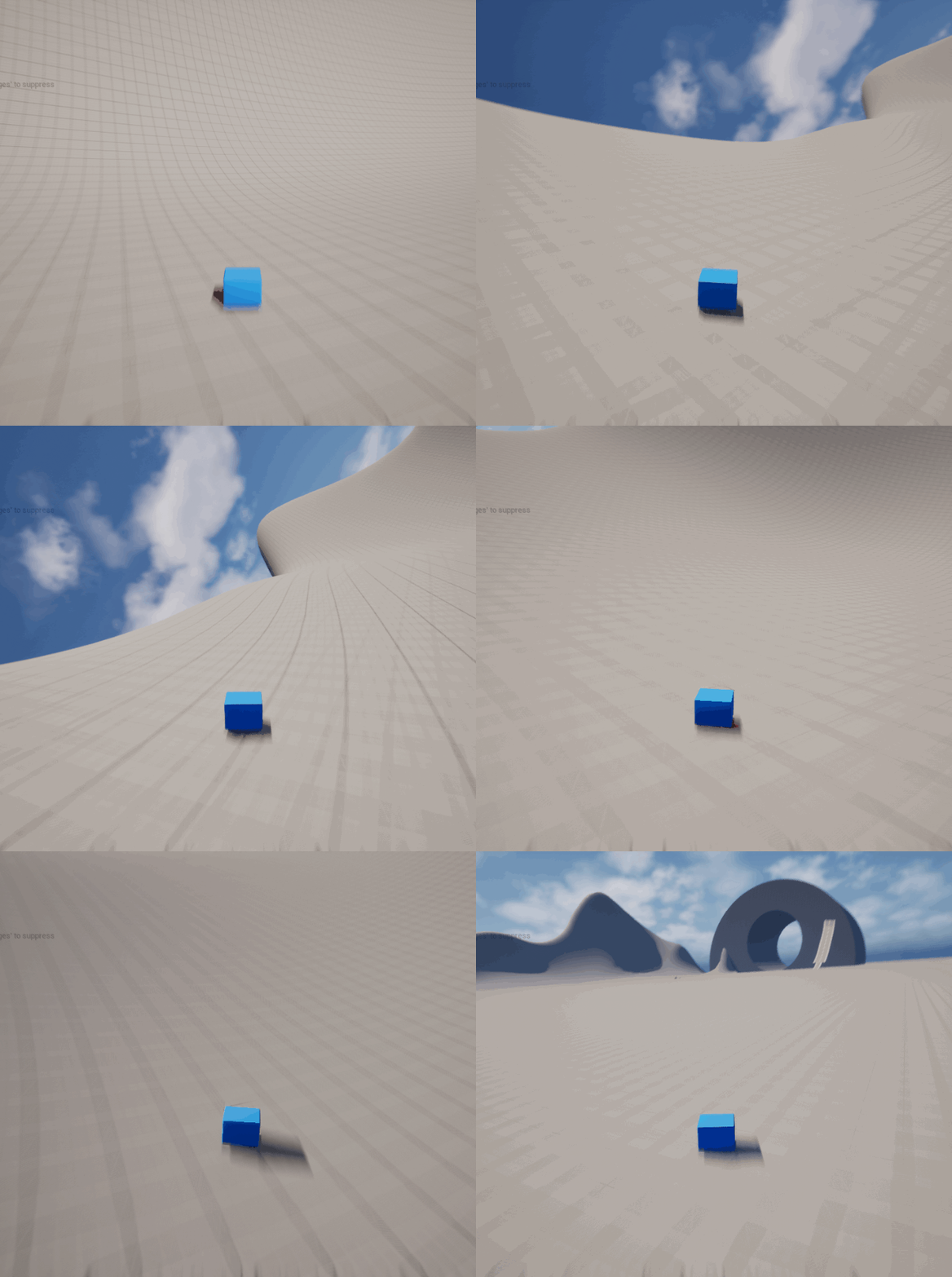
The very first kart controller I made for HardDriverz
Kart Physics Prototype
Early in development, I created a prototype kart controller that could drive up and down walls with ease. I did this by line tracing down (in the kart’s local space) from the kart’s center and then interpolating the kart’s up vector towards the normal of the impacted surface. This proof of concept became the groundwork for HardDriverz’s anti-gravity system. The gravity for a kart would be their local down vector at any given moment, allowing for unusual track configurations like loop-de-loops.
Together with Yunfan He and Caleb Won, we expanded the kart system to include better steering, drifting, and suspension. I focused on refining the kart’s throttle, deceleration, and braking. I also made designer tools called gravity regions that overwrote the gravity for karts within them. This was need for designers to make certain kinds of jumps and obstacles. Eventually I moved on to work on audio, but I would still occasionally assist with physics debugging problems as needed.
Audio Design and Implementation
I worked directly with the game’s lead designer Colin Park early on to define what the audio for the entire project should be like. Based on his vision for the rest of the game, I wrote the HardDriverz Audio Style Guide. This document detailed how all audio in the game should be created, from aesthetic considerations and references to technical requirements and specific techniques. This document was a constant reference for myself, the several other composers that worked on the game, as well as an additional sound designer.
I created and maintained additional audio documents throughout development, including an asset list, formalized feedback for our composer collaborators, and naming conventions and folder structure documentation for the various audio assets in-use.
Asset Management
I knew creating and implementing all the assets required for the entire game in the amount of time we had would not have been possible for one person alone. To address this, I mentored one of my colleagues, Peyton Walker, on some sound design fundamentals throughout development. By Alpha, she was able to assist me in creating and revising sound effect assets.
I tracked all planned audio assets (including SFX, music, and dialogue) in a spreadsheet, updating it throughout the project as assets were iterated on, completed, and removed.
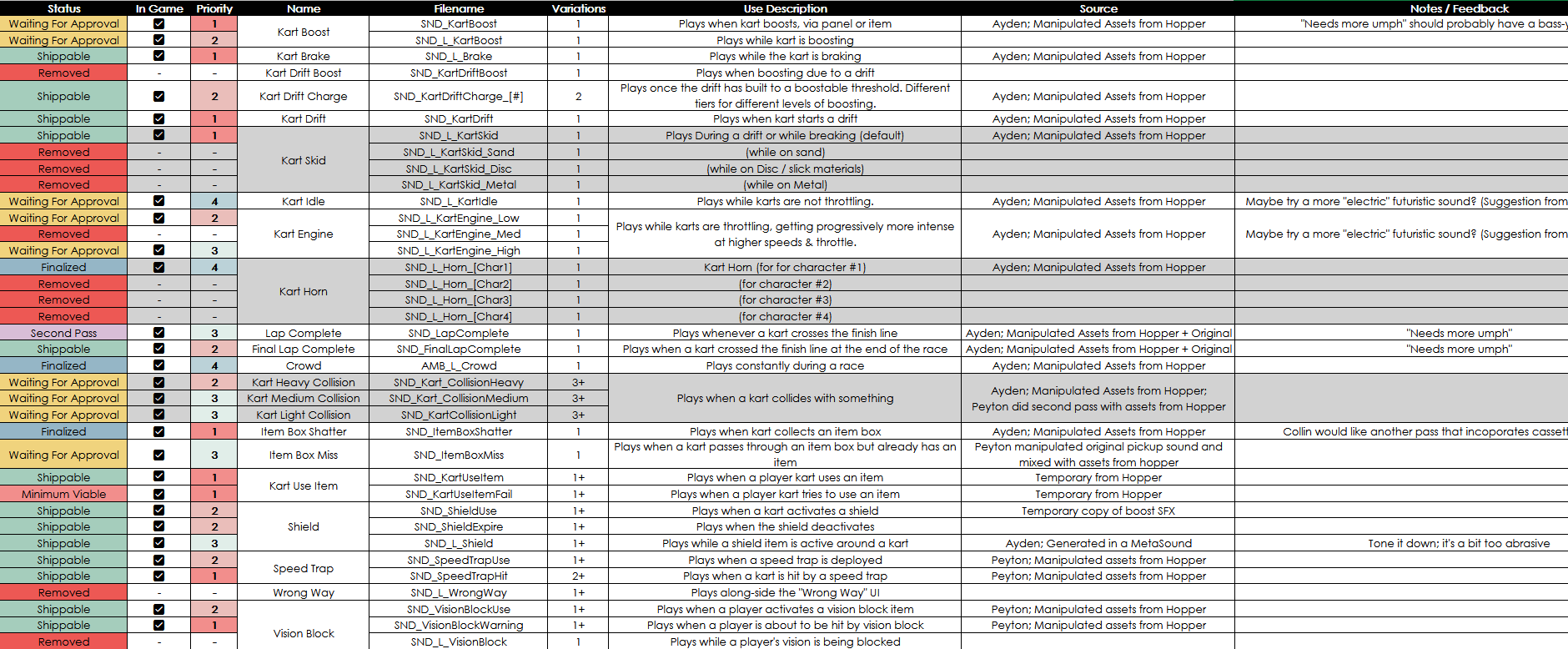
A screenshot of the SFX page on the audio asset list mid-development.
SMU Guildhall logo sequence w/ SFX
Sound Design
I created a majority of sounds found in the final game. Most of these sounds were made by first sourcing sounds from Guildhall’s internal SFX libraries then combining and manipulating them in Audacity, Ableton Live 11, and Adobe Audition to achieve the desired effect. A few sounds, such as the shield item, were created or supplemented with synthesis using basic waveforms.
In addition to the sound in the game, I provided sound design for the SMU Guildhall logo fly-in sequence that plays when launching the game.
Music Implementation
Early in development I knew I wanted to give races in HardDriverz an adaptive soundtrack. I settled on a design inspired by the common verse-chorus song form. The first half of each lap would correspond to a verse, while the second half would correspond to a chorus. This helps players build a subconscious association between sections of the race course and the music, contributing to a feeling of progression. On the third lap, the verse is replaced by a bridge. By breaking the pattern up until that point, we could make the third lap more exciting.
I wrote a simple music track during development to demonstrate these techniques. That track, along side the specifications in the Audio Style Guide (see above) were passed along to our composers. Later in development I would take the original demo track and flesh it out into the “Android Arena” track, which quickly became a favorite among the development team.
I implemented this music system using Unreal Engine’s MetaSounds. Each track is divided into several audio files representing each section; some made to loop, others only transitional. I created “gates” to would allow the music to proceed to the next section only if the “race progress” variable was sufficiently high.
In retrospect, I think this MetaSound in particular was a little messy; in particular I could’ve reduced the number of Wave Players and other repeated logic to improve readability. However, this system was more than adequate for HardDriverz, allowing me to simply swap in the appropriate music assets for each of the game’s three unique music tracks.